Clear view fencing is a run of welded steel mesh panels carried on posts set in concrete. You choose the height, the mesh opening, the coating and the gates. Price guides list common heights from 1.2 to 3.0 metres. Request a quote and we'll talk you through each choice for your boundary.
What are you actually buying?
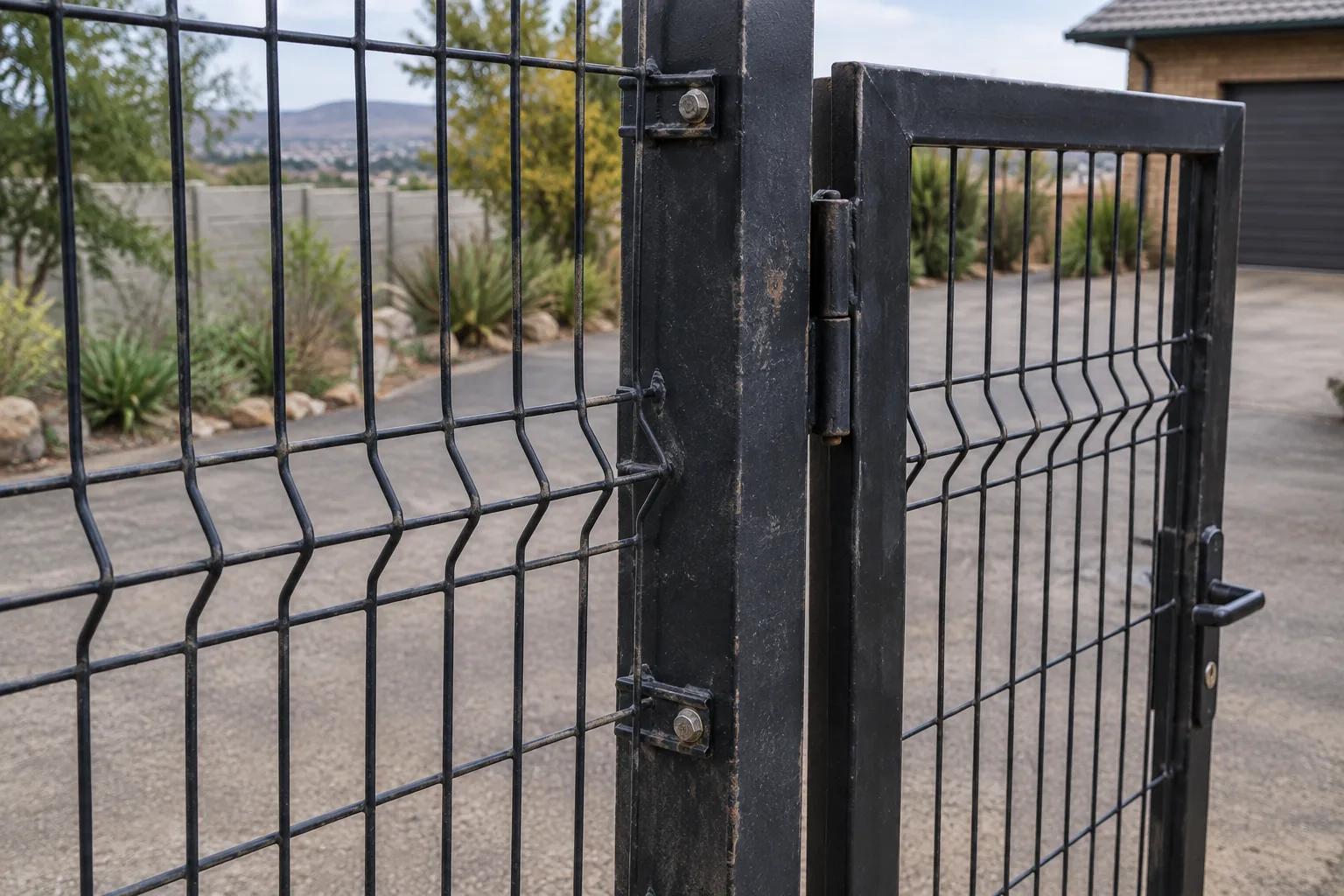
A clear view fence is three parts that work together: the mesh panels, the posts they are fixed to, and the gates that close the gaps. A quote that prices only the panels has left out the parts that cost the most time to put in.
- Panels. Flat sheets of welded wire, made in a range of wire thicknesses and mesh openings.
- Posts. Steel posts set in concrete footings. One Gauteng price guide describes post holes about every 2.4 to 3 metres.
- Gates. Pedestrian and vehicle gates in the same mesh or a matching frame. They are priced apart from the per-metre fence price.
Clear view fencing is also searched as ClearVu fencing. This page describes see-through welded mesh fencing in general.
Mesh grades in plain words
The mesh opening is the size of the rectangle between the wires. Smaller openings mean less to grip and less room to get a tool in. They also mean more wire, so they cost more.
One price guide splits mesh into three grades by opening size: a high-security grade of about 12.7 by 76.2 millimetres, a medium grade of about 25.5 by 76.2 millimetres and a low grade of about 50.8 by 76.2 millimetres. Another guide groups the same products as economy, standard and premium by wire thickness. Names and sizes differ between sellers, so ask for the actual opening and the wire diameter in millimetres, not only the grade name.
An anti-climb mesh is simply one with small openings, so it is a feature you can choose rather than a promise about what it will stop.
Heights and coatings
- Heights. One guide lists 1.2, 1.8, 2.1, 2.4 and 3.0 metres as common. Another says typical residential heights start at 1.8 metres.
- Coatings. Galvanised steel, powder coating and PVC coating all appear in price guides. Powder or PVC coating is quoted at roughly 20 to 30% more than plain galvanised in two of them.
- Colour. Black is described as the most popular, with other colours available on request.
- Add-ons. Anti-climb spikes, razor wire and electric fencing are listed as optional extras, each adding to the price.
Before you settle on a height, check what your municipality allows. A freestanding fence up to 1.8 metres may be treated as minor building work under the national building regulations, but that is not an automatic go-ahead. Get the municipality's written requirements or authorisation before you start. Taller fences and retaining walls need building control's answer first.
Gates and automation
The gate should match the fence beside it. For each gate, decide three things:
- Swing or slide. A sliding gate needs a clear run beside the opening. A swing gate needs room to open.
- Manual or automated. Automation, intercoms and access control are add-ons priced on their own. One Gauteng guide prices automated vehicle gates separately, and they can add a lot to the total.
- Where it sits. Gate position decides where the posts, the footings and any electric fence break have to go.
What an installation involves
Time on site varies with length, slopes and rock, so we give a time when we call you back rather than a number here. The steps are the same:
- Site visit or photos. Confirm the line, the length, the levels and the gate positions.
- Set out the line. Pegs or marks agreed with you before anything is dug.
- Dig and set posts. Post holes at the agreed spacing, then concrete footings, which need to set before the panels go on.
- Fix the panels. Panels are fixed to the posts and checked for line and level.
- Hang the gates. Hinges, latches and any automation are fitted and tested.
- Clean up. Soil, offcuts and packaging removed, and a walk-round with you.
If you want electric fencing on top, that adds steps of its own and a certificate: read what an electric fence install involves.
What we need from you
- The suburb and rough length of the boundary, in metres.
- Where gates should go, and what they should do.
- Whether the ground is flat, sloping or rocky, if you know.
- Whether the property is in an estate, complex or sectional title scheme, and who to ask about its rules.
- Whether there is an old fence or wall to take out, and who will dispose of it.
Ask for a clear view fencing quote
Give us your suburb and the length, and we'll phone to work through height, mesh and gates. For the price side, start with the cost guide. Weighing it against another style? Compare it with palisade fencing.
Sources for the figures on this page
- Post holes about every 2.4 to 3 m; concrete footings; automated vehicle gates a separate cost; electrification as an extra (Bastion Perimeter, published 5 Jan 2026) bastionperimeter.co.za
- Heights 1.2, 1.8, 2.1, 2.4, 3.0 m; galvanised and powder-coated finishes; black most popular; optional anti-climb spikes, razor wire and electric fencing; economy, standard and premium tiers (Perimifence, undated, checked 7 Nov 2026) www.perimifence.co.za
- Mesh opening grades about 12.7 x 76.2 mm, 25.5 x 76.2 mm and 50.8 x 76.2 mm; typical heights from 1.8 m; PVC coating 20 to 30% more (GEMSA, titled 2026, no date shown, checked 7 Nov 2026) gemsa.org.za
- Walls and fences up to 1.8 m described as minor building work; the owner should confirm the municipality's written requirements or authorisation before starting; rules vary by municipality (SANS 10400 site, article dated 25 Mar 2013, partly based on City of Cape Town policy; section 13 of the National Building Regulations and Building Standards Act allows the local authority to authorise or exempt in writing) www.sans10400.co.za